
Amplytico participates in the E-Verify program
Certified Small Business (SB/MB)
Certified Great Place to Work
582 Market St, Ste 1601, San Francisco, CA 94104
operations@amplytico.com
Copyright 2024 Amplytico Inc.
January 27, 2026
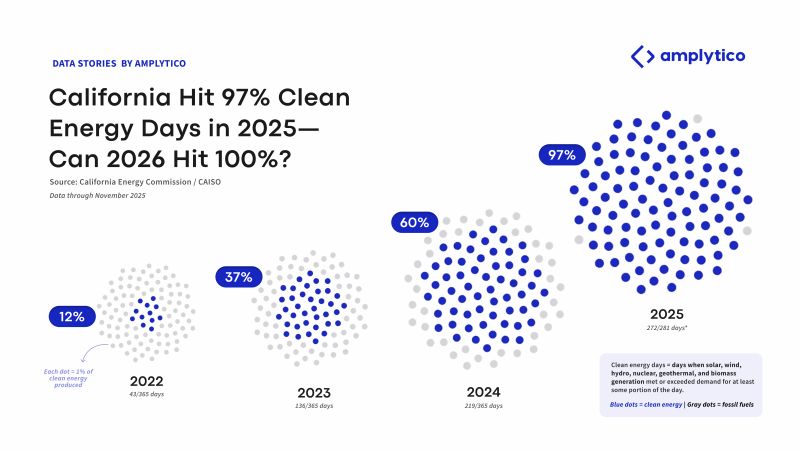
California hit a remarkable clean energy milestone in 2025—and the data tells a story of rapid transformation. Our latest Data Stories visualization shows how California went from just 43 clean energy days in 2022 (12%) to 272 days in 2025 (97%). That's an eight-fold increase in just three years.
What's a "clean energy day"? Days when solar, wind, hydro, nuclear, geothermal, and biomass generation met or exceeded demand for at least some portion of the day on California's CAISO grid.
The growth pattern is striking:
2022: 43 out of 365 days (12%)
2023: 136 out of 365 days (37%) — 3× growth
2024: 219 out of 365 days (60%) — continued acceleration
2025: 272 out of 281 days (97%) — only 9 fossil fuel days
What's driving this? As the California Energy Commission recently reported, the state ran on 100% clean energy for 1,856 hours in 2025—50% more than 2024. This growth is fueled by rapid expansion in solar and wind capacity, coupled with game-changing battery storage deployment that helps clean energy last longer than the sun or wind alone.
Why it matters: Each additional clean energy day means cleaner air for Californians, reduced reliance on high-emission resources during peak demand, and a more reliable, resilient grid. The state is proving that clean energy isn't just aspirational—it's becoming the norm, not the exception.
The question now: Can 2026 be the year California reaches 100% clean energy days? With only 9 fossil fuel days left to eliminate, the path is clear. California's grid transformation shows what's possible when policy, technology, and infrastructure align.
This is part of our Data Stories series, where we transform complex energy data into clear visual narratives for utility executives and industry stakeholders.
📊 Source: California Energy Commission / CAISO (data through November 2025)
What trends are you seeing in your region's energy transition? Share your observations in the comments.